

To track AI visibility, pick 10 to 30 questions your buyers ask AI assistants, run them on ChatGPT, Claude, Gemini, Perplexity and Google AI Overviews, and record which brands each answer names and which sources it cites. Then rerun the same questions every week or month and compare. Dashboards such as the Semrush AI Visibility Toolkit, Ahrefs Brand Radar, Peec AI, OtterlyAI and Profound do this on a subscription. Cite42 does it per call, with no subscription, through an API or from Claude Code and Codex over MCP.
Before publishing our own guides, we ran this process on Cite42. We asked 11 buyer questions on all five AI tools and got 54 completed answers. Cite42 was named in none of them. This guide shows how we set up that baseline, what it told us, what we changed and how we'll measure again with the same questions, so you can run the same experiment on your own brand.
Cite42 publishes this guide and ran the measurements on October 5, 2026. Every request and response is in the evidence file.
AI visibility tracking in five steps
- Choose 10 to 30 buyer questions and fix the wording.
- List the brands to track: yours, plus the competitors buyers weigh you against.
- Run a baseline on the AI tools your buyers use and save the raw results.
- Schedule the same questions weekly or monthly.
- Compare runs only when the questions, brands and AI tools match.
You'll also see this called LLM visibility tracking or AI brand monitoring. The measurements are the same: whether AI answers name you, how early they name you, and which pages they cite.
Our experiment: Cite42 in 54 AI answers
On October 5, 2026 we asked 11 questions a developer or marketer might type before choosing a tool like Cite42. Each question ran on ChatGPT, Claude, Gemini, Perplexity and Google AI Overviews, and each check tracked the same eight brands: Cite42, Semrush, Ahrefs, DataForSEO, SE Ranking, Profound, OtterlyAI and Peec AI.
Baseline, October 5, 2026
- Buyer question (shortened)
- Best SEO MCP servers for Claude and ChatGPT
- Cite42 named
- 0 of 5
- Most-named tracked brand
- Ahrefs, 5 of 5
- Buyer question (shortened)
- Tools for SEO and keyword research in Claude Code
- Cite42 named
- 0 of 5
- Most-named tracked brand
- Semrush and Ahrefs, 4 of 5
- Buyer question (shortened)
- MCP servers for Google Trends data
- Cite42 named
- 0 of 5
- Most-named tracked brand
- None of the eight
- Buyer question (shortened)
- AI visibility APIs without a monthly subscription
- Cite42 named
- 0 of 5
- Most-named tracked brand
- DataForSEO, 3 of 5
- Buyer question (shortened)
- DataForSEO alternatives for a solo developer
- Cite42 named
- 0 of 5
- Most-named tracked brand
- SE Ranking, 4 of 5 (DataForSEO is in the question)
- Buyer question (shortened)
- Tools that track the URLs AI answers cite
- Cite42 named
- 0 of 5
- Most-named tracked brand
- Profound, 4 of 5
- Buyer question (shortened)
- Tracking brand visibility in ChatGPT and AI search
- Cite42 named
- 0 of 5
- Most-named tracked brand
- Semrush, 4 of 5
- Buyer question (shortened)
- ChatGPT keyword research with real search volume
- Cite42 named
- 0 of 4
- Most-named tracked brand
- Semrush and Ahrefs, 4 of 4
- Buyer question (shortened)
- Keyword research APIs for developers
- Cite42 named
- 0 of 5
- Most-named tracked brand
- DataForSEO, 5 of 5
- Buyer question (shortened)
- Content gaps from AI answers and keyword demand
- Cite42 named
- 0 of 5
- Most-named tracked brand
- Semrush, 5 of 5
- Buyer question (shortened)
- AI visibility tools across ChatGPT, Claude, Gemini and Perplexity
- Cite42 named
- 0 of 5
- Most-named tracked brand
- Semrush, 5 of 5
- Coverage: 55 answers requested, 54 completed. The Google AI Overviews check for H returned an error, so H counts four answers and the failure stays out of the total instead of being scored as a miss.
- Result: Cite42 was named in 0 of 54 completed answers.
- Cost: $2.19 for the 11 rankings checks, and $3.46 for all 20 research calls that day, including keyword, Trends and citation checks.
- Methodology version:
2026-09-28-v1:aio-v2. A rerun needs the same version to be comparable.
The table shortens each question. The evidence file has the exact wording, which is what a rerun should use.
What the baseline told us
A zero becomes useful once you look at who was named instead. Three patterns stood out.
Established suites own the general SEO questions. Semrush and Ahrefs were named in four of five answers about SEO in Claude Code and in all four completed answers about ChatGPT keyword research. A new tool earns a place by answering a narrower question better, such as how to get real keyword volume inside Claude Code.
Developer API questions go to DataForSEO. It was named in all five answers about keyword research APIs and in three of five about AI visibility APIs without a subscription. Its pricing page states pay-as-you-go terms plainly, which is exactly what that second question asks for.
Setup questions go to GitHub. The Google Trends MCP question named none of the eight tracked brands, and a separate citation check showed those answers citing GitHub repositories, MCP directories such as Glama, and integration pages. The SEO MCP answers cited comparison articles instead, including a list of SEO MCP servers published by SE Ranking itself.
A follow-up check on October 6 made the pricing point sharper. Asked for "an AI visibility API I can use pay-as-you-go, without a monthly subscription", Perplexity recommended Local SEO Data, whose page says "no subscription required, funds never expire". Gemini recommended Serpent API, described as a "pure pay-as-you-go credit system with no monthly subscription". Both descriptions fit Cite42, and none of our pages said so in those words.
What we changed before measuring again
We wrote one guide for each buyer question:
- Guide written for it
- SEO MCP servers compared
- Guide written for it
- Keyword research in Claude Code and Codex
- Guide written for it
- Google Trends in Claude through MCP
- Guide written for it
- AI visibility APIs compared
- Guide written for it
- DataForSEO alternatives
- Guide written for it
- AI citation tracking
- Guide written for it
- This guide
- Guide written for it
- ChatGPT keyword research with real volume
- Guide written for it
- Keyword research APIs
- Guide written for it
- Content gap analysis for AI answers
- Guide written for it
- AI visibility tools
Then we rewrote them around what the baseline showed. Every guide now states Cite42's billing in one plain sentence: pay per call, no subscription, a balance that never expires. Comparisons include the tools assistants already name, such as Semrush, Ahrefs, DataForSEO and OtterlyAI, and say where each one fits. Setup guides include commands you can copy and the real results they returned.
How we'll measure again
We'll rerun the same 11 questions, word for word, with the same eight brands on the same five AI tools, and report the result here next to this baseline with its own evidence file. We'll wait until the guides have been live long enough to be crawled, because a check the day after publishing mostly measures crawl delay.
Three rules apply when we read the rerun, and they apply to yours too:
- Read every count with its denominator. One mention in five answers is one answer, and it says nothing about 20% of buyers.
- Keep failed checks out of the count.
- If the methodology version changes, treat the rerun as a new baseline.
Cite42 tracker reports build in the same caution: they withhold percentage-point changes when a metric group has fewer than ten answers in a run.
Step 1: Choose questions that represent a buying decision
Good tracking questions describe a job, a constraint or a comparison in a buyer's words, such as "Which tools can I use for SEO and keyword research in Claude Code?" or "What AI visibility APIs can developers use without a monthly subscription?" A broad question ("What is AI search?") or a branded one ("Is Cite42 any good?") tells you little about whether buyers find you.
- Fix the wording, and leave out dates such as "best tools this month".
- Watch for competitors named in the question. In "best alternatives to DataForSEO", DataForSEO appears in almost every answer.
- Start with 10 to 30 questions. A Cite42 tracker holds up to 30.
- Version the list. Adding branded questions later raises your mention rate with nothing else changing.
Google keyword volume can show which topics people care about. It counts Google searches, though, so treat it as a hint about AI prompts rather than a measure of them.
Step 2: Pick a dashboard or a pay-per-call API
Dashboards run your prompts on a schedule and add reports, share-of-voice charts and team features. The Semrush AI Visibility Toolkit, Ahrefs Brand Radar, Peec AI, OtterlyAI and Profound are the names AI answers mention most. As of October 2026, OtterlyAI's Lite plan is $29 a month for 15 prompts on ChatGPT, Google AI Overviews, Perplexity and Microsoft Copilot, according to its pricing page. The AI visibility tools comparison covers the rest.
Cite42 is a pay-per-call API and MCP server for AI visibility tracking. There is no subscription: you top up a prepaid balance (minimum $25.00), the balance never expires, and you pay only for successful calls. A verified signup adds $1.00 of free credit. A brand check costs $0.05 on ChatGPT alone, $0.08 on ChatGPT and Perplexity, and $0.20 across all five AI tools.
Two limits to weigh before choosing Cite42. It covers ChatGPT, Claude, Gemini, Perplexity and Google AI Overviews, and leaves out Microsoft Copilot, Google AI Mode and Meta AI. Its trackers run weekly or monthly, so daily data means scheduling REST calls yourself.
Step 3: Run a baseline from Claude Code or Codex
Connect Cite42's hosted MCP server and sign in. The Claude Code and Codex setup guide has the full walkthrough.
# Claude Code
claude mcp add --transport http --scope user cite42 https://mcp.cite42.dev
claude mcp login cite42

# Codex
codex mcp add cite42 --url https://mcp.cite42.dev
codex mcp login cite42
Then ask for a rankings check on one question:
Use Cite42 rankings for:
"Which tools can I use for SEO and keyword research in Claude Code?"

Track Cite42, Semrush, Ahrefs, DataForSEO and SE Ranking.
Use ChatGPT and Perplexity.

Show each brand's mentions with the number of completed answers,
first-mention positions, cited sources and any failed checks.
Keep the exact question and inputs in the report.
That check costs $0.08. From your own code, the same request is a POST to https://www.cite42.dev/api/v1/rankings, documented in the rankings API reference.
Read the raw result before you schedule anything:
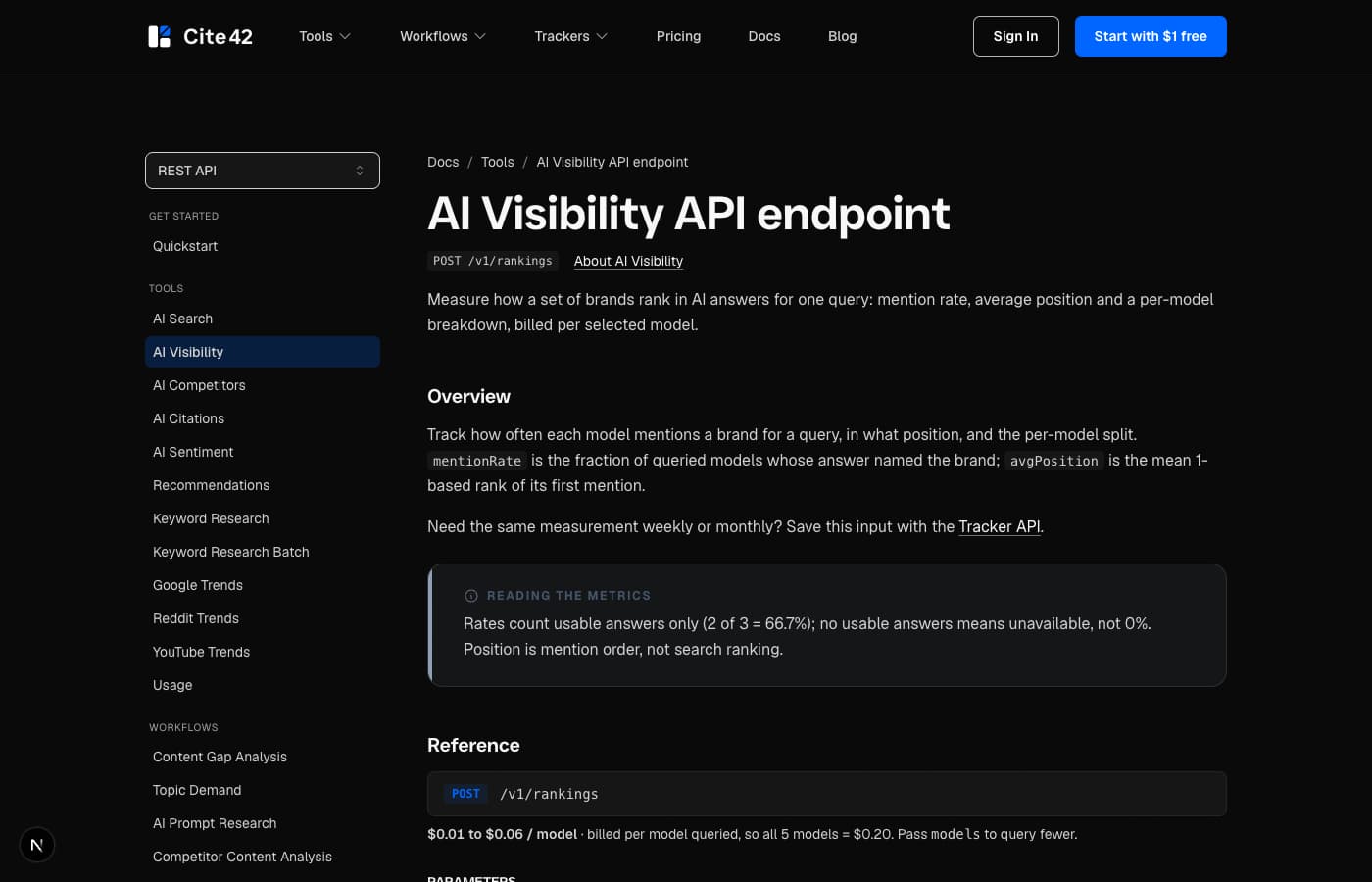
- Mention rate is the share of completed answers that named the brand.
- Average position is the order in which tracked brands were first named. It isn't a Google ranking or a measure of how strongly an answer recommends a brand.
- Sources lists the URLs the answers cited. An answer can name a brand without citing its site, so to check one specific page, run a citations check with a watched URL, as the citation tracking guide shows.
- Failed checks are excluded. If nothing completed, the result is unavailable, which is different from zero.
- Cached results are the same observation. Cite42 caches recent answers, so an immediate repeat isn't a new sample.
Cite42 queries ChatGPT, Claude and Gemini through their official APIs with web search enabled, Perplexity through its own search, and Google AI Overviews from live Google results. Answers can differ from what a signed-in person sees in the consumer app; the methodology page has the details.
Step 4: Create a weekly or monthly tracker
A Cite42 tracker applies one measurement (rankings, citations, compare or sentiment) to up to 30 questions and reruns it weekly or monthly, keeping every run's results. In Claude Code or Codex, ask for cite42_tracker_create with inputs like these:
{
  "name": "Cite42 developer buyer prompts",
  "primitive": "rankings",
  "prompts": [
    "Which tools can I use for SEO and keyword research in Claude Code?",
    "What are the best MCP servers for accessing Google Trends data?",
    "What AI visibility APIs can developers use without a monthly subscription?"
  ],
  "competitors": ["Cite42", "Semrush", "Ahrefs", "DataForSEO", "SE Ranking"],
  "models": ["chatgpt", "perplexity"],
  "cadence": {
    "frequency": "weekly",
    "weekday": 1,
    "time": "09:00",
    "timezone": "Europe/London"
  }
}
Set the timezone and time for your team; weekday 1 is Monday. Trackers store an exact models list (ChatGPT, Perplexity and Gemini if you leave it out) and have no fullSweep option, so the cost you approve stays fixed.
Creating a tracker saves a draft and charges nothing. The response includes estimatedCostMicroPerRun, the cost of one run in micro-credits (100,000 micro-credits equal $1). To start the schedule, activate it with that exact number as maxCostMicroPerRun. Activation authorizes billed runs until you pause the tracker, and it needs a balance that covers at least one run. Editing the prompts, AI tools or measurement returns the tracker to draft, so you activate again with the new estimate. Over REST, the same steps are POST /api/v1/trackers and POST /api/v1/trackers/{id}/activate, described in the tracker API reference.
At current prices, the three-question draft above costs $0.24 per run, about $1.04 a month on a weekly schedule averaged over a year. Our full 11-question baseline on all five AI tools would cost $2.20 per run, or about $9.53 a month weekly. A citations tracker on the same questions is billed separately.
Turn each gap into a page
Each question where you're missing points to a page you can improve. If comparison articles dominate the cited sources, publish a clear comparison that includes the incumbents. If GitHub repositories and directories dominate, publish working setup with commands people can copy, and keep your directory listings accurate. If a competitor gets named for a constraint you also meet, such as "no subscription", say so in one plain sentence on the relevant page.
Google's guidance on AI features says the usual SEO best practices still apply to AI Overviews and AI Mode, and that no special markup or AI text file is needed to appear in them.
Frequently asked questions
How can I track my brand's visibility in ChatGPT and other AI search engines?
Pick 10 to 30 questions your buyers ask, run them on ChatGPT and the other AI tools you care about, and record whether each answer names your brand and which sources it cites. Rerun the same questions weekly or monthly. Dashboards such as the Semrush AI Visibility Toolkit, Ahrefs Brand Radar, Peec AI and OtterlyAI do this on a subscription, while Cite42 does it per call through an API or MCP with no subscription.
What is LLM visibility tracking?
LLM visibility tracking measures how often answers from ChatGPT, Claude, Gemini, Perplexity and Google AI Overviews mention your brand, how early they mention it and which pages they cite. It's another name for AI visibility tracking. The core metrics are mention rate, first-mention position and cited sources, measured on a fixed set of prompts over time.
How much does AI visibility tracking cost?
Dashboards charge a monthly subscription that grows with prompt count and AI engines; OtterlyAI's Lite plan, for example, is $29 a month for 15 prompts (October 2026). Cite42 charges per check with no subscription: $0.20 for one question across five AI tools, and a weekly tracker of three questions on ChatGPT and Perplexity averages about $1.04 a month. The minimum top-up is $25.00, and the balance never expires.
Can I track AI visibility from Claude Code or Codex?
Yes. Add Cite42's hosted MCP server at https://mcp.cite42.dev to Claude Code or Codex, sign in, and ask for a rankings check or a tracker in plain language. The setup guide has the full steps.
How often should I rerun AI visibility checks?
Weekly or monthly suits most brands, because new pages take time to be crawled and cited. Keep the questions, brands and AI tools identical between runs so the numbers stay comparable. Cite42 trackers run on weekly or monthly schedules.
Run your own baseline
Create a free Cite42 account for $1.00 of credit, connect Claude Code or Codex, and run one buyer question with your brand and three competitors. Once you know which questions matter, save them as a tracker. The AI visibility tool page and pricing cover the rest.